Benchmarks
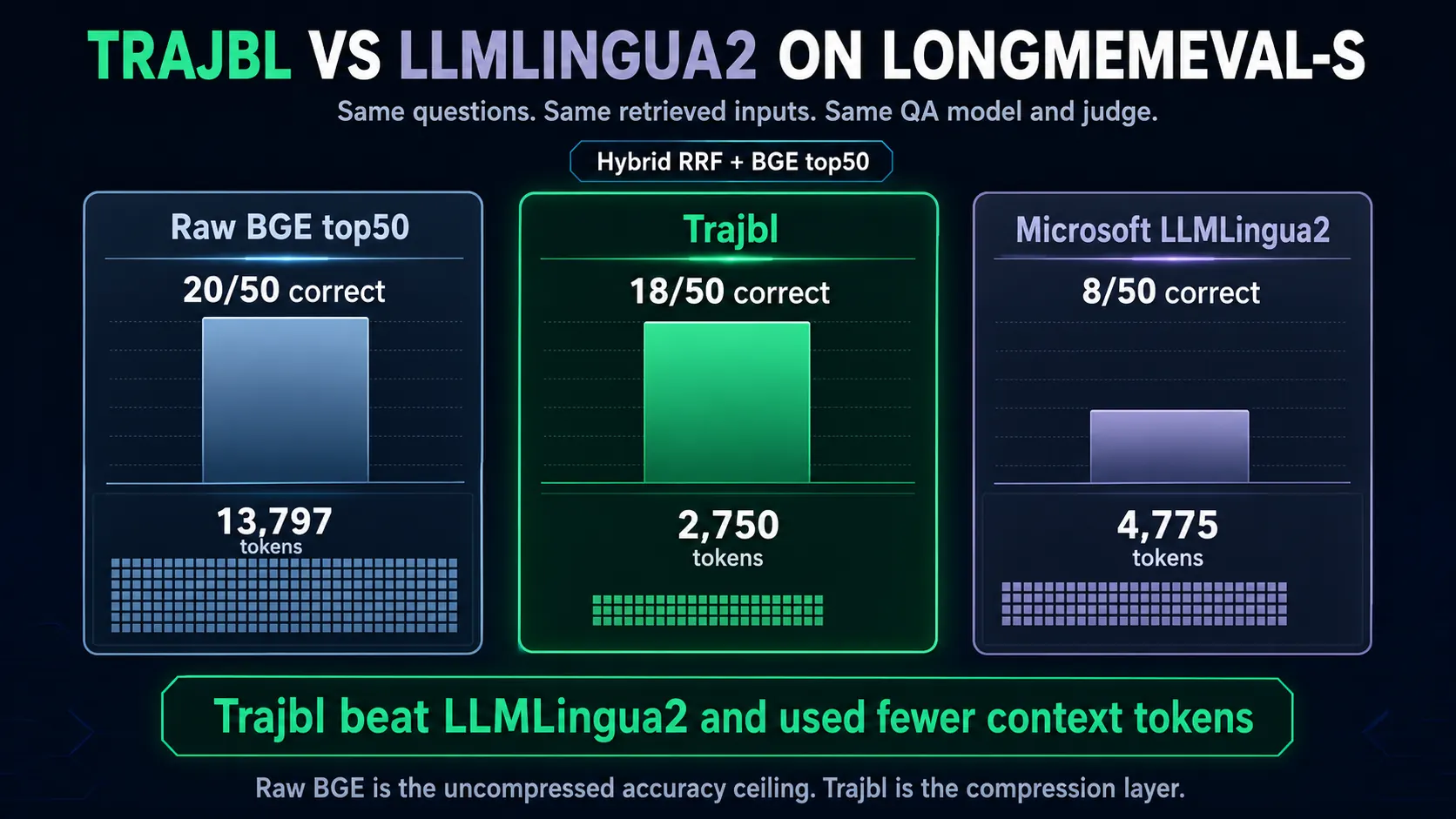
Trajbl beat LLMLingua2 on quality-per-token.
The current public-facing evidence comes from controlled public benchmark suites such as LongBench-style multi-hop QA and WixQA-style support workloads. The fair interpretation: Trajbl is a post-retrieval compressor, not a full retriever.
Highest-quality branch
Full context is the quality ceiling. Trajbl keeps much of it with far less context.
In the long-context benchmark signal, Trajbl retained 68% of the full-context reference quality while cutting context tokens by about 88%. LLMLingua2 retained about 40% quality at a similar token budget.
Long-context comparison
Relative quality and token efficiency.
Higher quality is better. Lower context size is better. The headline is not raw retrieval accuracy; it is compression quality at a much smaller context budget.
| Method | Quality | Quality retained | Mean context tokens | Token reduction |
|---|---|---|---|---|
| Full RAG reference | 0.587 F1 | 100% | 10,593 | 0% |
| Trajbl | 0.400 F1 | 68% | 1,313 | ~88% |
| LLMLingua2 | 0.233 F1 | 40% | 1,405 | ~87% |
Compression baselines
Trajbl also beat stronger LongLLMLingua-style baselines.
This is the clearest public-facing chart: Trajbl stays model-free and CPU-first while outperforming model-based compression baselines in the measured long-context comparison.
Cost correction
~$0.26 actual LLM estimate
The old run summary showed $6.23 because the harness added a fixed $0.01 per judge row. The QA calls cost about $0.233 and the estimated judge cost is about $0.023. Future runs now log measured judge cost.
Next validation
Infra benchmark required
Before broad market claims, we will measure cold start, mean/p95 latency, RAM, CPU, throughput, and cost per 1,000 queries by stage: retrieval, BGE, Trajbl, LLMLingua2, LLM, and judge.
CurveMemory research appendix
Routing metrics remain promising, but they are no longer the main product headline.
CurveMemory is kept as a research track for geometric routing. The immediate product focus is Trajbl as a compressor for existing RAG and agent stacks.
CurveMemoryFAISS HNSWFAISS Flat
CurveMemory measured data
Research routing methods at a glance.
| Method | Accuracy | Total latency | RAM delta | Index |
|---|---|---|---|---|
| CurveMemory | 81.8% | 0.109 ms | 0.02 MB | 55.5 KB |
| Semantic Router TF-IDF | 64.6% | 1.268 ms | 6.16 MB | Not reported |
| Semantic Router MiniLM | 92.2% | 8.29 ms | 330.38 MB | 675 KB |
| FAISS Flat + MiniLM | 93.1% | 6.14 ms | 195.7 MB | 675 KB |
| FAISS HNSW + MiniLM | 93.1% | 5.89 ms | 197.95 MB | 738.3 KB |
Scale data
CurveMemory research scale measurements.
| Documents | Curve latency | HNSW latency | Curve RAM | HNSW RAM | Curve index |
|---|---|---|---|---|---|
| 10,000 | 0.020 ms | 0.109 ms | 1.53 MB | 19.33 MB | 0.36 MB |
| 50,000 | 0.012 ms | 0.169 ms | 3.67 MB | 80.47 MB | 1.08 MB |
| 100,000 | 0.013 ms | 0.203 ms | 5.71 MB | 161.00 MB | 1.81 MB |
| 250,000 | 0.043 ms | 0.345 ms | 10.30 MB | 400.01 MB | 2.91 MB |
Benchmark workstation
Intel Core i9-12900KF
16 cores / 24 logical processors / 32 GB RAM / Windows 11 Pro 64-bit
CurveMemory routing and CPU baseline measurements were executed on CPU. The installed RTX 3080 was not used for those routing measurements.
CPU12900KFLocal benchmark