Retrieve
Your existing RAG stack finds candidate messages, chunks, notes, or documents.
Trajbl sits between retrieval and the LLM. It receives a retrieved context pool, keeps complete evidence sentences, and builds a compact packet that the model can answer from.
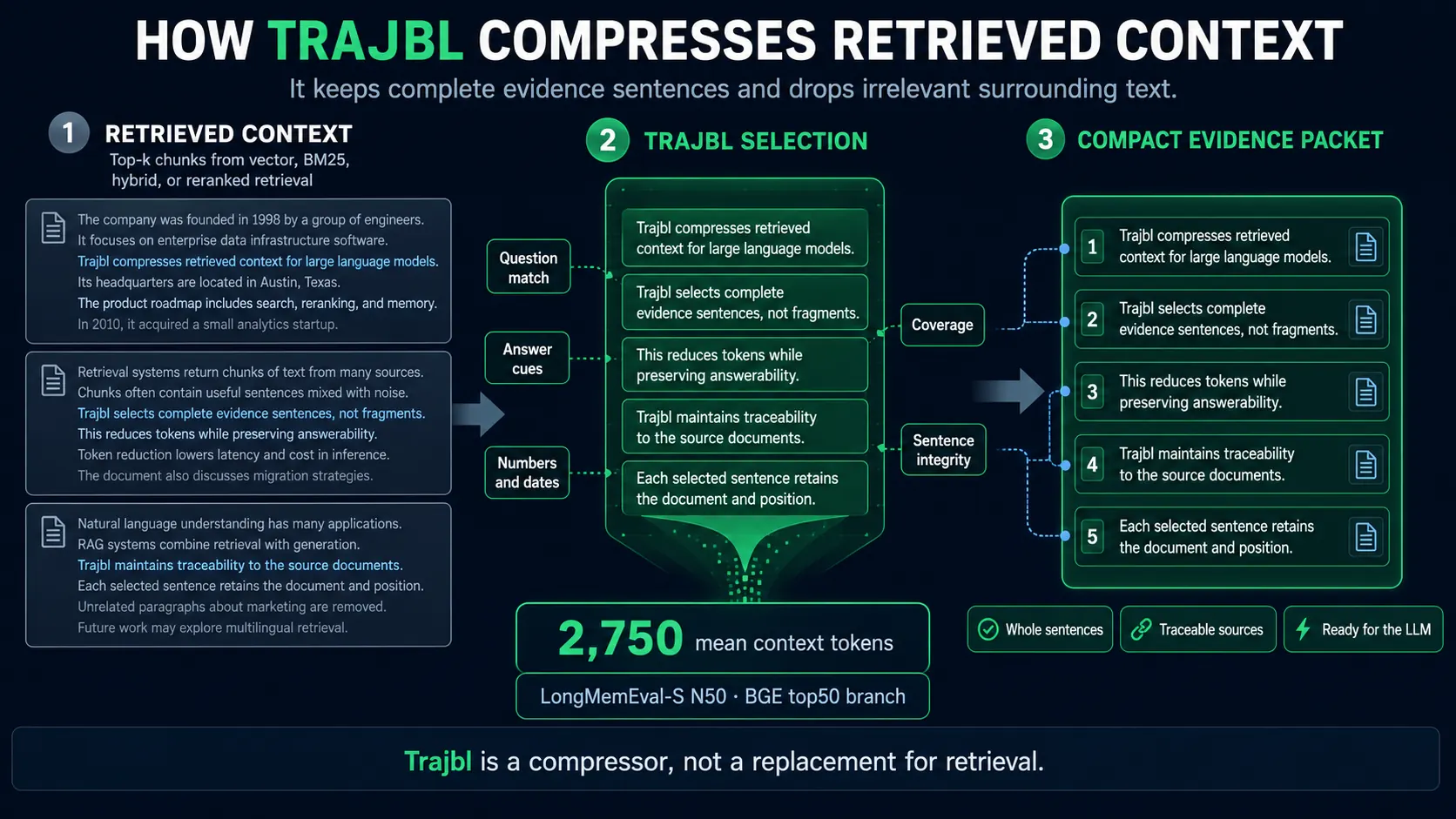
Good compression needs a good input pool. The fair production setup is: existing retriever top50 to Trajbl to LLM. That is why the benchmark compares Trajbl and LLMLingua2 over the same vector, hybrid, and BGE-reranked retrieval setups.
Your existing RAG stack finds candidate messages, chunks, notes, or documents.
Optional vector, hybrid RRF, or BGE reranking creates a stronger top50 context pool.
Trajbl keeps a small source-traceable packet of complete evidence sentences.
The LLM reads less context while preserving the facts most likely to answer the question.
Full-context RAG remains the quality ceiling. Trajbl's job is to preserve much of that answer quality while sharply reducing the context packet. In the measured long-context comparison, Trajbl retained more quality than LLMLingua2 at a similar token budget.
Trajbl remained ahead of LLMLingua2 and LongLLMLingua-style compression in the measured long-context signal.
Selected evidence remains readable and verbatim instead of becoming disconnected token fragments.
The selector balances relevance, answer cues, and evidence coverage while keeping implementation details proprietary.
The retained packet can preserve a trace back to the documents or messages that supplied it.
Trajbl is a local preprocessing layer and does not require a GPU or hosted compression model.