Enterprise knowledge chat
Compress retrieved policies, project notes, tickets, and internal documentation before they reach the LLM.
Existing retrievalTrajbl compresses
Trajbl is designed as a practical plugin layer: existing RAG or agent retrieval finds candidates, then Trajbl packs a smaller evidence packet before generation.
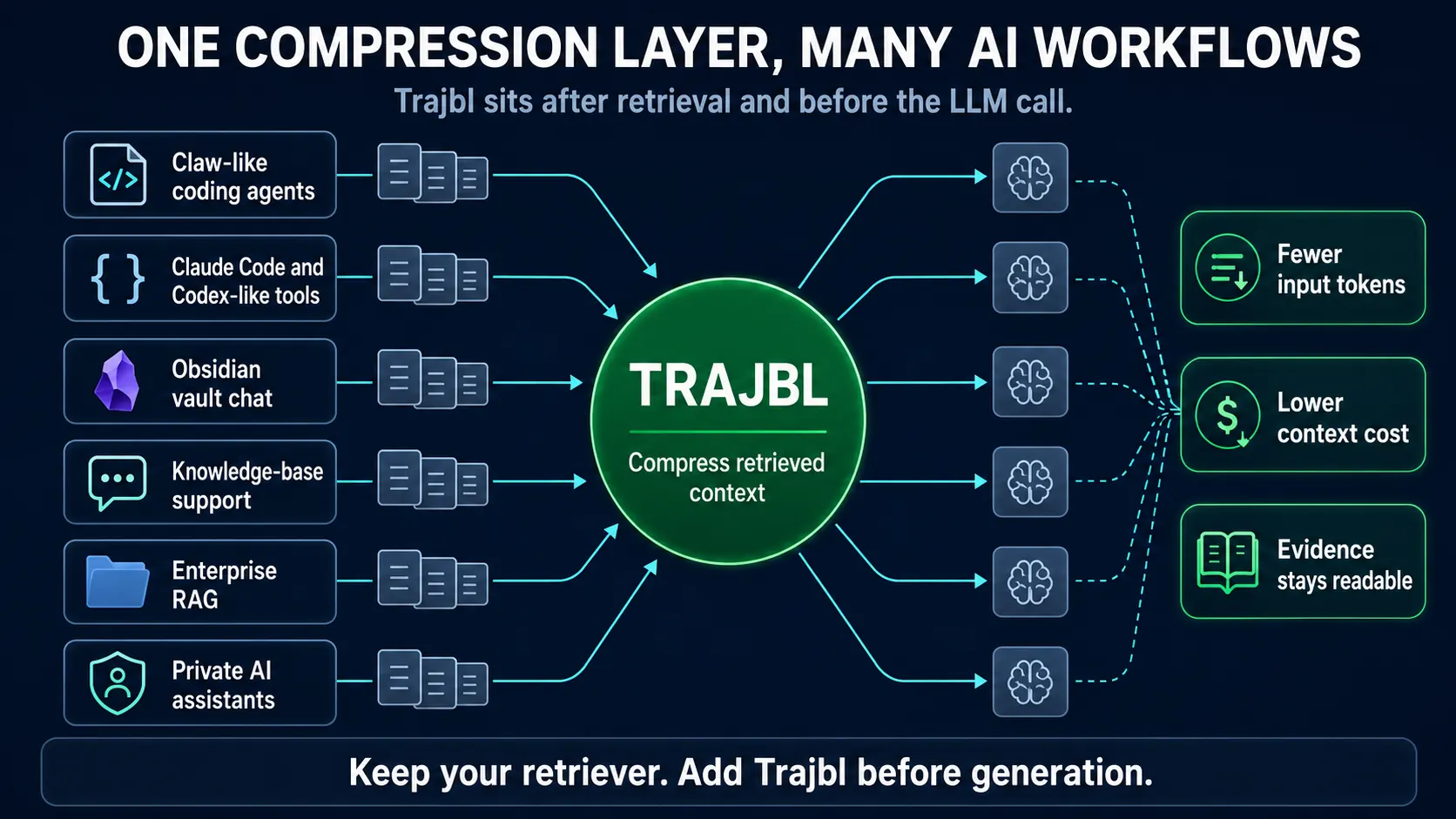
Compress retrieved policies, project notes, tickets, and internal documentation before they reach the LLM.
Keep long-running agent context smaller while preserving the evidence sentences needed for the next action.
Add Trajbl after vector, BM25, hybrid, or reranked top-k retrieval to reduce context load without replacing the current stack.
Build smaller answer packets that keep complete source sentences instead of fragmenting key clauses.
Reduce dense technical context while retaining numbers, dates, entities, and traceable evidence.
Send fewer help-center, account, and policy snippets to the model while keeping answerable context.
Run CPU-first compression where a GPU-backed compression model is not practical.
Keep retrieval and compression inside a controlled customer or VPS environment.
A practical pilot should compare raw top-k context, LLMLingua2 compression, and Trajbl compression on the same retrieved inputs, with accuracy, token savings, latency, and failure cases logged.